






























| Doc's Guide Service 2250 Leisure Lane Mercer, WI 54547 715-476-2305 Cell: 715-776-7693 www.docsguideservice.com doc@docsguideservice.com Visa & Mastercard Accepted |

| For all your lodging needs, please visit Northland Lodging. (Click Logo) |









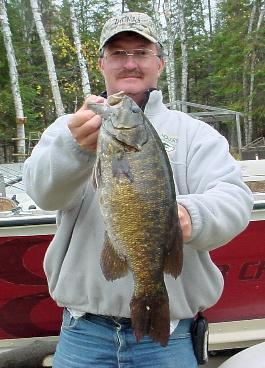
| Spring: Smallies in their pre-spawn or active spawn are very aggressive during May and early June. Bigger females are in close to shore relating to the rocky-sandy areas looking for or on their spawning beds. Drifting into these areas or using your trolling motor to position your boat will create less chance of spooking these shallow water fish. I like to work these areas with a 7' medium action rod spooled with 10-14lb. test line. Bait of choice for fishing this type of structure and other structures that I will mention further on is the ISG 4" scented tube jig, crawdad, gobee, and watermellon red have always been the most productive presentation. Cast these shallow water areas up close to shore in as little as a foot of water and swimming the tube out, keeping the presentation fairly close to the bottom. Letting the tube settle to the bottom and sudden quick jerks of it will also trigger strikes. Summer-Fall: After the spawn, (usually end of May to mid June) the TFF smallies head to their summer and fall locations. Although some do take up their summer and fall haunts in the shallow rocks and sand close to their spawning grounds, most head to the center lake mud humps. These mud humps are scattered though out all areas of the TFF. Locators are a must for finding the humps. Best humps come from out of 14 feet of water or deeper and up to as shallow as 4 feet. The humps lined with submerged stumps or topped off with a rock base are always the best. Humps can range in size from the size of a 16 foot boat to as large as 100 yards by 100 yards. Once finding the hump you would like to fish, mark it with a bouy and back off till you see on the graph where the edge of the hump drops off. Again I like to use the same tackle set up and presentation as mentioned for the spring smallies. Start by casting your tube jig to the shallowest portion of the hump, swimming the tube back to the boat by lifting and dropping the tip of your rod trying to keep slight contact with the bottom. Make sure to work all areas and edges around and on top of the hump. Watch your graph as you move around the hump for submerged stumps and sharp breaks. These can be key areas that hold the best fish. If you locate a stump or stumps on or on the edge of the hump try vertical jigging your tube straight down into the structure, lifting and dropping. Lots of these stumps have excellent root systems which the smallies love to hang tight in on certain days and vertical jigging is the only way to get them to hit. Pound for pound small mouth are one of the best fighting fish around. Plus adding the above average size, you are sure not to be disappointed with the smallie action the Turtle Flambeau Flowage produces. Mike "Doc" Sabec is a Wisconsin Licensed Guide that specializes in walleye and small mouth fishing on the Turtle Flambeau Flowage. Doc is a lifetime resident of Mercer, WI., and has been fishing the Turtle Flambeau Flowage for 39 years. Doc can be reached at 715-476-2305 Office * 715-776-7693 Cell * email doc@docsguideservice.com |
| Turtle Flambeau Flowage Smallies By Guide Mike "Doc" Sabec Although much known for its fantastic walleye fishing the Turtle Flambeau Flowage also boasts a excellent population of Small Mouth Bass. With 17,000 acres of superb small mouth habitat, abundant feed, and acres of prime spawning areas the small mouth population on the Turtle Flambeau Flowage has exploded in the last six years. Commonly referred to as "footballs", the Turtle Flambeau Flowage produces much heavier smallie than the average inch to pound ratio than most other bodies of water.From early spring to late fall the small mouth can be found roaming the various structures of the TFF. Not knowing where to start can always be a tough way to start a fishing trip, lets narrow down the searching a bit. |