



























| Turtle Flambeau Flowage Walleyes: The famous Turtle Flambeau Flowage, (17,000 acres of water) is rated by the Wisconsin D.N.R. as having one of the best walleye populations per acre of water in the state. Laid out with open mud flat areas, miles and miles of river channels, log jams, rock, and sand shorelines, submerged as well as visible stump fields, hundreds of center lake rock and mud humps, back bays, islands, bogs, and numerous weed beds allows “Doc” to teach you numerous presentations that put walleyes in the boat. |

| Turtle Flambeau Flowage Small Mouth Bass: Although much known for its fantastic walleye fishing the Turtle Flambeau Flowagealso boasts a excellent population of Small Mouth Bass. With 17,000 acres of superb small mouth habitat, abundant feed,and acres of prime spawning areas the small mouth population on the Turtle Flambeau Flowage has exploded in the last 10 years. Commonlyreferred to as “footballs”, the Turtle Flambeau Flowage produces much heavier smallie than the average inch to pound ratio than most other bodies of water. From early spring to late fall the small mouth can be found roaming the various structures of the TFF. |

| The walleye is one of the most highly prized game fishes in Wisconsin. Thousands are caught each year during their spring spawning runs. Walleyes are primarily minnow feeders, but leeches, small bullheads, night crawlers, and various small plugs are favorite baits. In clear waters, walleyes usually stay in deeper areas during the day, moving into the shallows at night. In more turbid waters, they can be caught throughout the day. The large, unusual eyes of the walleye are designed to help them easily find their prey. State Record: Walleye 18 lbs. 0 oz. 09/16/1933 High Lake Vilas County |
| Pound for pound the smallmouth bass is the scrappiest fish of all Wisconsin. It is usually associated with a rocky stream or lake environment where its favorite food, the crayfish, is abundant. Some of the best lake fishing takes place in June during, and just after, the spawning season, and in early fall. Natural baits like hellgrammites, dragonfly larvae and crayfish are especially effective during early morning or late evening. (Note: in Wisconsin it is illegal to possess live crayfish while fishing or while possessing angling equipment on any inland water, except the Mississippi River.) Probably the best artificial baits are those used on the surface. Light tackle is ideal. Fish quietly, casting toward rocks or logs, keeping the rod tip up the line taut. State Record: Smallmouth 9 lbs. 1 oz. 06/21/1950 Indian Lake Oneida County |
| Smallmouth |

| The natural home for the musky is in the northern lakes and rivers. It is a solitary fish and lurks in weed beds or other protective cover. Anglers usually have the best luck fishing during the daytime. Large plugs, spoons, and bucktails are the best artificial baits. A live fish bait 10-12 inches long is also good. State Record: Muskellunge 69 lbs. 11 oz. 10/20/1949 Chippewa Flowage Sawyer County |
| Crappie |

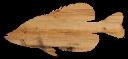
| The black crappie is considered an excellent game fish when taken on light tackle. Extreme care must be taken in landing these fish because their mouths are very tender. Anglers specializing in catching black crappie know that to be successful the bait must be kept constantly moving. The best baits are small minnows, small maribou-covered jigs, plastic minnows, or small streamer flies cast along the outer edges of weed beds. The crappie lies in weed beds in deep water during the day and bite best in early morning or toward evening. In summer, with the abundance of small fish for feed, they are more difficult to catch. Small minnows are used as bait in winter. State Record: Crappie, Black 4 lbs. 8 oz. 8/12/1967 Gile Flowage Iron County |

| Plain garden worms are the favorite bait for bluegills, but they can be caught on a number of different types of lures. The fly fisher can have fun with poppers, especially in spring and early summer, when nests are concentrated in shallow water. Most large bluegills are taken in deep water during the summer months by drifting with the wind using worms. Wintertime jigging in the weed beds with grubs or mousies on ice jigs also produce excellent results. State Record: Bluegill 2 lbs. 9.8 oz. 8/02/1995 Green Bay Brown County |
| Walleye |
| Musky |

| Northern Pike |
| Bluegill |
| Unlike other common species of game fish, northern pike are most active when the water is cool. The northern pike is quite accommodating to anglers, biting best during the daylight hours. Being a predator, northerns prefer live fish baits, and wobbling spoons. They are a favorite target of ice fisherman with tip-ups. State Record: Northern Pike 38 lbs. 0 oz. 8/06/1952 Lake Puckaway Green Lake County |


| Yellow perch are primarily bottom feeders with a slow deliberate bite. They eat almost anything, but prefer minnows, insect larvae, plankton, and worms. Tackle may range from a simple handline or a fly rod in summer to a short, whippy, jigging rod in winter. Because perch prefer cooler water, the best fishing is usually in deep water. Perch move about in schools, often numbering in the hundreds. If one spot is unproductive after a few tries, it is best to move to other spots until a school is located. State Record: Perch, Yellow 3 lbs. 4 oz. 1954 Lake Winnebago Winnebago County |

| Yellow Perch |

| Doc's Guide Service 2250 Leisure Lane Mercer, WI 54547 715-476-2305 Cell: 715-776-7693 www.docsguideservice.com doc@docsguideservice.com Visa & Mastercard Accepted |

| For all your lodging needs, please visit Northland Lodging. (Click Logo) |
